
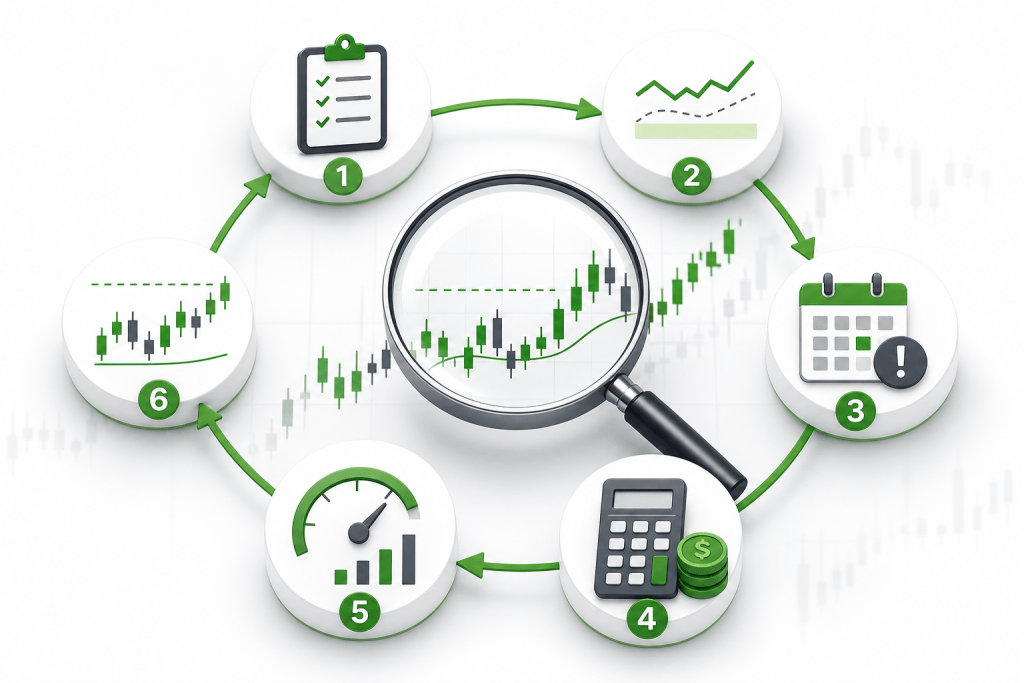
Day trading SPY starts before the open: check the economic calendar, mark the prior day’s high, low and close, and write down a bias and the price that would cancel it. During the session, size every trade from a fixed risk limit, act only at levels you marked, place the stop when you enter, and be flat before the close.
Most traders who struggle with SPY don’t fail on analysis. They fail on process. They open the chart at 9:30 a.m. ET with no levels marked, no bias and no loss limit, then chase the first candle. This guide is one repeatable session, from the pre-market plan to the last exit. For how options on the index products work in general, see our guide to index options trading.
Why Traders Choose SPY for Day Trading
SPY is the SPDR S&P 500 ETF Trust, a fund that tracks the S&P 500 and is one of the largest ETFs in the world, as its fund page at State Street shows. For day traders, size means depth: the shares and the options trade heavily all day, so the gap between bid and ask is usually small and getting in and out is rarely the problem.
That liquidity makes SPY cheap to trade. It doesn’t make your decisions good. Everything below is about the decisions.
The Six Steps of a SPY Session
- Check the economic calendar. Note the time of every high-impact release.
- Set a daily bias. Long, short or neutral, and the price that would change your mind.
- Size the position from a risk limit you set before the session.
- Wait for the trigger at a level you marked in advance.
- Place the stop the moment you enter.
- Exit and be flat before the close.
Steps 1 and 2 happen before the open. Steps 3 to 5 happen only when your trigger appears, and step 6 ends the day on your terms. The usual failure runs in reverse: a trader skips the first three steps, then tries to repair the trade with step 5 after the loss has started.
Steps 1 and 2: The Pre-Market Plan and Daily Bias
Step 1: the calendar. Look for the releases that move the whole market: inflation data, the monthly jobs report and Federal Reserve decisions. Write down the exact times. SPY can reprice within seconds of a release, so decide in advance whether you will trade through it or stand aside. Our guide to how CPI and jobs reports move the market shows what those minutes look like.
Step 2: the bias. A bias is a working view, not a prediction. Mark the prior day’s high, low and close, because the market keeps coming back to those three prices. Then see where SPY is trading before the open:
- Above the prior close and holding: a long lean.
- Below the prior low: a short lean.
- Inside the prior range with no direction: neutral, which means waiting.
Write the bias next to the price that would cancel it. A bias with no cancel price is only a hope. Turn on extended hours on your chart, or the pre-market prices won’t show.
When you finish, the plan fits on one card: release times, the three prior-day levels, your bias and its cancel price. From then on, the market has to come to your levels.
Confirming a Trade: VWAP and Market Internals
The level gives you the trade. These tools tell you whether the broad market agrees, so treat them as a filter, never as the trigger.
- VWAP, the volume-weighted average price, shows where the day’s volume has changed hands. SPY reclaiming a marked level while holding above VWAP supports a long; failing below VWAP at a resistance level supports a short.
- $TICK compares the stocks ticking up with those ticking down at each moment. A long trigger carries more weight when the reading leans positive and stays there; a single spike tells you little.
- $ADD tracks advancing minus declining stocks through the day. A break above a level with $ADD rising has broad participation behind it. A push higher while $ADD sags is narrow, and narrow moves fail more often.
There is no reliable magic number for $TICK or $ADD. Learn how they behave on your own charts over several weeks of sessions. A level with no confirmation is a lower-conviction setup: take it smaller, or skip it. For more of the signals index traders watch, see seven market signals every index options trader watches.
Steps 3 to 5: Size, Trigger and Stop
Step 3: size from a fixed risk limit. Decide what you will lose if the trade fails, then work back to the number of shares or contracts. The stop distance sets the size, not your confidence. A wider stop means a smaller position.
Step 4: wait for the trigger. Act only at or near the levels in your plan, for example a reclaim of the prior day’s high with VWAP and internals agreeing. If price drifts between levels, do nothing. Waiting is a decision.
Step 5: place the stop on entry. Put it at the price that proves the setup wrong, when you enter. A stop you plan to place later, or keep in your head, is not a stop.
Account rules matter too. In a cash account, you have to pay for each purchase with settled funds before you sell it, or you risk a good-faith violation. In a margin account, FINRA sets a $2,000 minimum and your broker checks your margin through the day; an account that keeps running intraday deficits can lose margin trading for up to 90 days. FINRA’s guide to frequent intraday trading explains both. Your broker’s own rules can be stricter, so check them before you build a daily routine.
How SPY Moves Through the Day, and Where 0DTE Fits
The open. The first 30 to 60 minutes after 9:30 a.m. ET are usually the most volatile. Overnight news and gaps get resolved, and option spreads are at their widest. Many traders let the first minutes pass and act on the first clean test of a level.
The midday lull. Volume thins and price tends to chop between levels. This stretch punishes overtrading. If your bias has played out or failed, having no position is fine.
The close. Direction often returns in the final hour. This is also where step 6 matters: being flat before the close removes the risk of an overnight gap you didn’t plan for.
Same-day (0DTE) options. Contracts expiring today carry little time value, so small moves in SPY produce large percentage swings in the option. That magnifies gains and losses alike, and it makes small size and a firm stop more important, especially in the last hour, when expiring contracts react to every tick.
SPY Shares, SPY Options or S&P Futures
| Instrument | What it is | Who it suits |
|---|---|---|
| SPY shares | Units of the fund, with no expiry | Traders learning the process who want simple sizing and no time decay |
| SPY options | Contracts on the fund, including same-day expiries | Traders with a defined-risk plan who can handle expiry and tighter timing |
| S&P 500 futures (ES, MES) | Exchange-traded contracts on the index itself | Experienced traders who want nearly 24-hour access and accept margin risk |
The shares trade in pre-market and after-hours sessions, but with less volume and wider spreads, so trade smaller outside regular hours and use limit orders. S&P futures trade almost around the clock; our guide to the ES and NQ overnight session covers what changes after the cash close. Once you trade, keep every session in a log, such as our SPY trade log template.
FAQs
Can you trade SPY after hours?
Yes, the shares trade in pre-market and after-hours sessions at most brokers, though you may need to enable extended hours and use limit orders. Volume is thinner, so spreads widen and fills are less reliable. SPY options generally trade only during regular market hours.
Is it easier to day trade the SPY shares or SPY options?
The shares are simpler: no expiry, no time decay and straightforward sizing. Options give you magnified exposure and a known maximum loss on long positions, but they need tighter timing, and same-day contracts move sharply on small price changes. Many traders learn the session process on shares first.
How do you day trade SPY on a small account?
Risk a fixed small share of the account on each trade and let the stop distance set the size. If the stop is too wide for that limit, skip the setup. Check your broker’s cash-account and margin rules before you trade often, since they decide how freely you can trade in and out.
What’s the difference between SPY and S&P 500 futures?
SPY is a fund that trades on an exchange like a stock during market hours, plus extended sessions. ES and MES futures are contracts on the index itself that trade nearly around the clock and use margin, which magnifies gains and losses. SPY is simpler to size; futures suit traders who need access outside the regular session.
What is the best time of day to trade SPY?
Most of the movement comes in the first hour and the last hour, with a quieter stretch in between. The open offers the most opportunity and the most risk. Many traders do their best work on the first clean level test after the open, then trade less through midday.
Conclusion
Day trading SPY comes down to repeating one process: plan before the open, mark your levels, set a bias with a cancel price, size from a fixed risk limit, act only at your levels, stop on entry and be flat before the close. The instrument matters less than whether you follow the sequence every session.
Next, write your pre-market card: release times, the prior day’s high, low and close, your bias and its cancel price. Run it for several sessions at small size, and review each one before you change anything.
To see a defined supply and demand method applied to SPY and other index options in real time, Base Membership sends live index options alerts with entry and exit targets, with strategy support in Slack. See Base Membership on our Services page.
Educational content only, not investment advice. Options and futures trading involve substantial risk of loss and are not suitable for every investor. Blueville Capital LLC is not a registered broker or financial advisor.
Free weekly email
Every alert, every Friday
The Weekly Alert Report: every alert we sent that week, winners and losers, with the high each one reached.


