Trading the ES and NQ Overnight Session: What Moves Price Before the Open
Trading Education ·
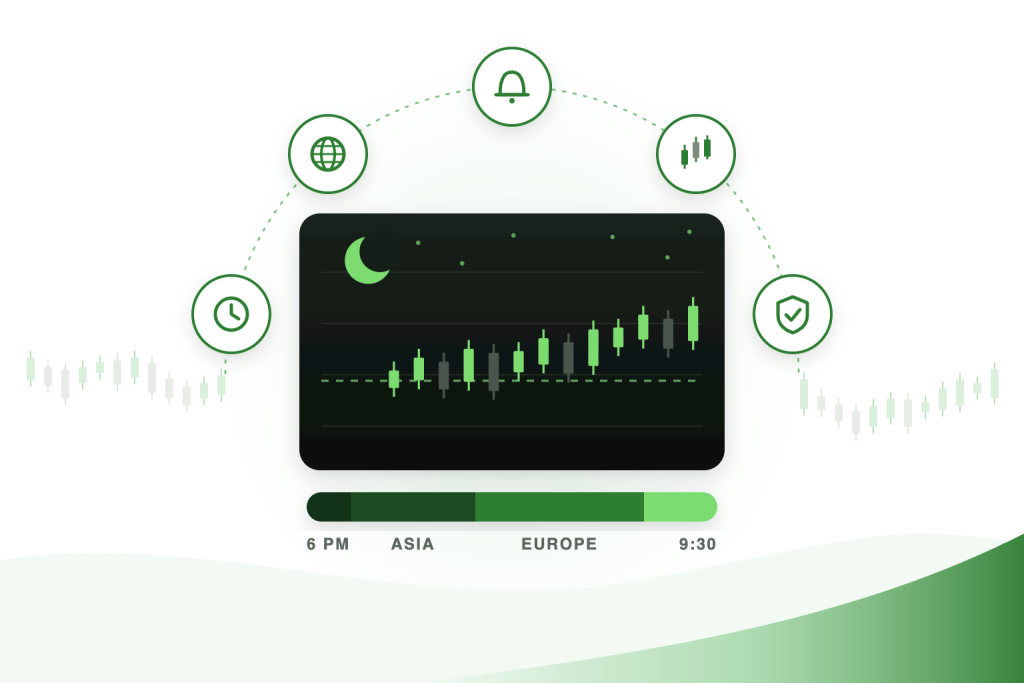
The overnight session in ES and NQ futures runs from 6:00 p.m. ET, when CME Globex reopens after its daily one-hour break, to 9:30 a.m. ET, when the New York Stock Exchange opens. It is a real market that reacts to Asia, Europe, earnings released after the close and 8:30 a.m. economic data, but with fewer resting orders than the day session. Trading it well comes down to three things: smaller size, levels marked before you start, and knowing which scheduled events fall inside the window.
This guide breaks the night into its working parts, shows how the overnight tape differs from the regular session, and walks through a sizing example with E-mini and Micro E-mini contracts. If you are new to the futures clock itself, start with our guide to futures trading hours for ES, NQ and YM. This article picks up where that one leaves off and focuses on how to trade the hours between the evening reopen and the cash open.
What counts as the overnight session
CME lists E-mini S&P 500 futures as trading on Globex from Sunday 6:00 p.m. to Friday 5:00 p.m. ET, with a daily maintenance period from 5:00 to 6:00 p.m. ET (CME Group, E-mini S&P 500 contract specs). E-mini Nasdaq-100 futures follow the same Globex week (CME Group, E-mini Nasdaq-100 contract specs). The stock market’s core session runs from 9:30 a.m. to 4:00 p.m. ET (NYSE hours and calendars).
So in practice, “overnight” means 6:00 p.m. to 9:30 a.m. ET: about fifteen and a half hours in which the futures trade and the stocks inside the index do not. Traders call the stock-market hours RTH (regular trading hours) and the rest ETH (electronic or extended trading hours). Charts that include ETH look different from RTH-only charts, so decide which one your levels come from and use it consistently.
CME states its hours in Central time, and Central and Eastern time change for daylight saving on the same dates, so these Eastern times hold all year. What shifts with the seasons is when the foreign markets open in Eastern time.
The four stretches of the night
6:00 to about 7:00 p.m. ET: the reopen
The first hour after the maintenance break reacts to whatever happened after the 4:00 p.m. stock close: earnings from large companies, guidance changes, late headlines. On Sunday evening, this is where weekend news gets priced. Expect a thin order book. A market order can fill several ticks away from the last trade, and a quick spike can reverse just as quickly.
7:00 p.m. to about 2:00 a.m. ET: Asia
The Tokyo Stock Exchange opens at 9:00 a.m. Japan time, which is 7:00 p.m. ET in winter and 8:00 p.m. ET in summer, because Japan does not use daylight saving time. Unless there is news from Japan or China, a central bank decision or a sharp move in currencies, this stretch often builds a range rather than a trend. Many index futures traders use it to watch, not to trade.
About 3:00 to 8:30 a.m. ET: Europe
The London market opens at 8:00 a.m. U.K. time. That is 3:00 a.m. ET for most of the year, and 4:00 a.m. ET for a few weeks in March and around the end of October, when the U.S. and U.K. change their clocks on different dates. European cash trading and European economic data bring new orders into ES and NQ, and it is common to see the Asian range tested here. Watch how price behaves at the zones you marked: a clean rejection during European hours shows you who is active at that level before U.S. traders arrive.
8:30 to 9:30 a.m. ET: U.S. data and the pre-market
The Bureau of Labor Statistics releases the Consumer Price Index, the monthly jobs report and the Producer Price Index at 8:30 a.m. ET (BLS release schedule). With the stock market still closed, ES and NQ take the first reaction. On a data morning, treat 8:30 as its own event with its own size and its own plan, and check the calendar every evening so it never catches you holding a full-size position.
How the overnight tape differs from the day session
- Fewer resting orders. With less size waiting in the book, stops slip further and a single large order can move price several ticks. Check the depth on your platform before you enter, not after.
- News hits a thinner market. Earnings after the close, comments from central bankers and geopolitical headlines move price faster at 2:00 a.m. than at 2:00 p.m.
- Price limits and pauses. CME applies price limits to U.S. equity index futures outside regular hours and can pause trading after a fast move. The current levels are in its equity index price limits FAQ. A limit event can leave you unable to exit at your stop.
- Ranges are the default. Without a catalyst, many nights rotate inside the prior day’s range. Breakouts that start at 3:00 a.m. on no news often fail by the open, so ask what is driving a move before you join it.
Levels to mark before you trade the night
The overnight session rewards preparation more than reaction. Before 6:00 p.m., or before you sit down for the European session, mark:
- The prior regular session’s high, low and close. Overnight trade often reacts at these, because the next day’s cash session will start from them.
- The overnight high and low as they form. Once Asia has built a range, its edges become the first levels Europe tests.
- Supply and demand zones on 30- and 60-minute charts. Zones where price left quickly with little trading show where unfilled orders may still sit. Our guide to supply and demand zones covers how to draw them; the same method works on ES and NQ.
- The scheduled times. Earnings after the close, any foreign central bank decision and the 8:30 a.m. U.S. releases. Write them on the chart so you see them before you place an order.
A worked sizing example
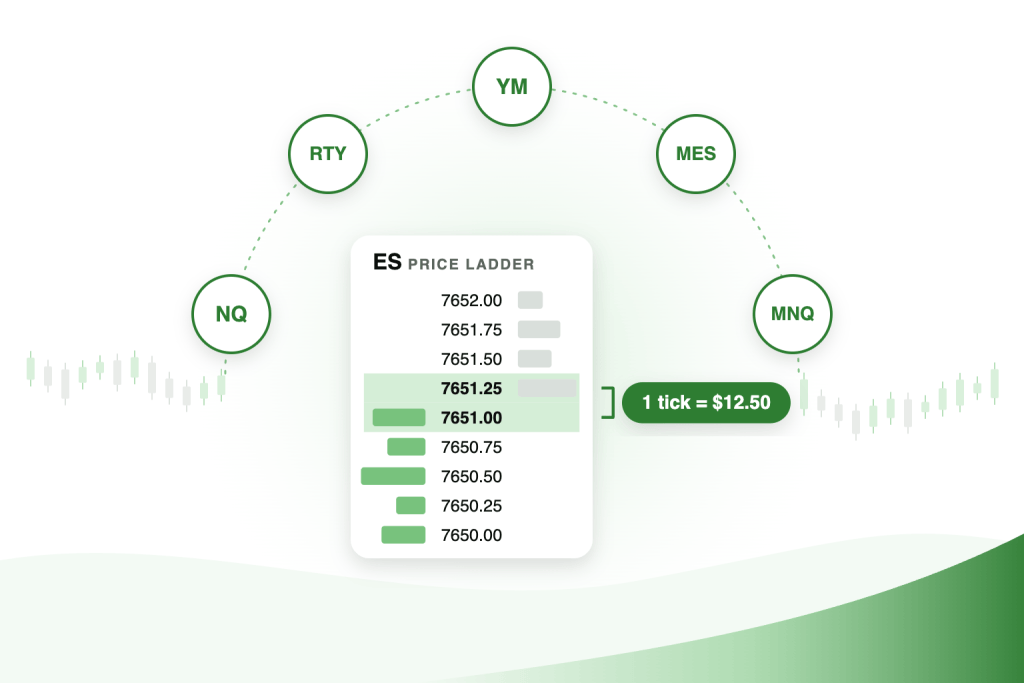
One ES contract is $50 times the S&P 500 index, so each 0.25-point tick is worth $12.50 and each full point $50. One NQ is $20 per point, with a 0.25-point tick worth $5.00 (CME Group). The Micro E-mini contracts are one-tenth the size: MES is $5 per point and MNQ $2 per point (CME Group, Micro E-mini S&P 500 specs; Micro E-mini Nasdaq-100 specs).
Blueville’s futures setups use a 5-point stop, with a slippage buffer of 0.25 to 3 points added to the entry’s limit price, so a trade can risk up to 8 points. Say you trade a $50,000 account and risk 1% per trade, $500, during the day session. Overnight, you cut that in half to $250 because the book is thinner, and you count the full 3-point buffer. Now take two setups:
- ES long from a demand zone. At 8 points, one ES risks 8 × $50 = $400, more than your $250 budget, so you cannot take even one. One MES risks 8 × $5 = $40, so 6 MES risk $240.
- NQ short from a supply zone. At 8 points, one NQ risks 8 × $20 = $160, so 1 NQ fits ($160), the same position as 10 MNQ.
This is why micro contracts matter overnight. The stop stays at 5 points; when one E-mini is more than the budget, the contract count changes instead. Our futures position size calculator does the arithmetic for any account. Our guides to MES and NQ and MNQ cover each contract in more depth.
Deciding what to do at 9:30
An overnight position faces one more event: the cash open, when the stocks in the index start trading and volume returns. Decide before you enter whether you will close the trade before 9:30, take partial profits, or hold through the open with a stop that still fits your budget. If the market is set to open well away from the prior close, the gap itself becomes a setup; our guides to trading NQ gaps at the open and ES pre-market analysis walk through that morning routine.
Common overnight mistakes
- Trading all fifteen hours. Pick the stretch that suits your schedule and setups, usually the reopen or Europe, and stay out of the rest.
- Using day-session size. The same stop in points can cost more overnight once slippage is added.
- Market orders in a thin book. Use limit orders to enter. Keep your stop as a stop.
- Forgetting the calendar. An 8:30 release or a big earnings report can move price through your stop before you see it.
- Moving the stop while you sleep on it. If you cannot watch the trade, the stop you set at entry is the plan. Do not widen it at 3:00 a.m.
How Blueville trades the overnight session
Blueville Capital’s Futures Add-On sends live futures alerts during the overnight and morning sessions, with setup reviews and text support while the session runs. It is booked per session and open to members and non-members. Blueville suggests a portfolio of $25,000 or more for it, and $50,000 or more is ideal.
Frequently asked questions
Is the overnight futures session less liquid than the day session?
Usually, yes. Fewer orders rest in the book outside U.S. stock-market hours, especially in the first hour after the reopen and during the Asian session. That means more slippage on stops and faster moves on news. Your platform’s depth of market shows how much size is waiting at each price.
Can I trade ES on Sunday evening?
Yes. CME Globex opens E-mini S&P 500 futures at 6:00 p.m. ET on Sunday, and the week runs to 5:00 p.m. ET on Friday, with a one-hour break each weekday from 5:00 to 6:00 p.m. ET.
Do micro futures trade overnight?
Yes. MES and MNQ trade on the same Globex schedule as ES and NQ, which makes them the practical choice for smaller overnight positions.
Does the overnight move tell me where the market will close?
No. It tells you where buyers and sellers have agreed on price so far, in a thinner market than the one that arrives at 9:30. A move with a clear cause, such as an economic release or a large company’s earnings, has a reason to carry into the open; a drift on no news has less. Treat the overnight range as a set of levels, not a forecast.
Conclusion
The overnight session is a market of its own: open for most of the day, thin in places, and moved by a clear schedule of Asian, European and U.S. events. Mark your levels before it starts, pick the stretch you will trade, size down with micro contracts, and decide in advance what you will do at 9:30. If you want live setups through the overnight and morning sessions, with someone reviewing them as they happen, see the Futures Add-On on our Services page.
Educational content only, not investment advice. Futures trading involves substantial risk of loss and is not suitable for every investor. Blueville Capital LLC is not a registered broker or financial advisor.