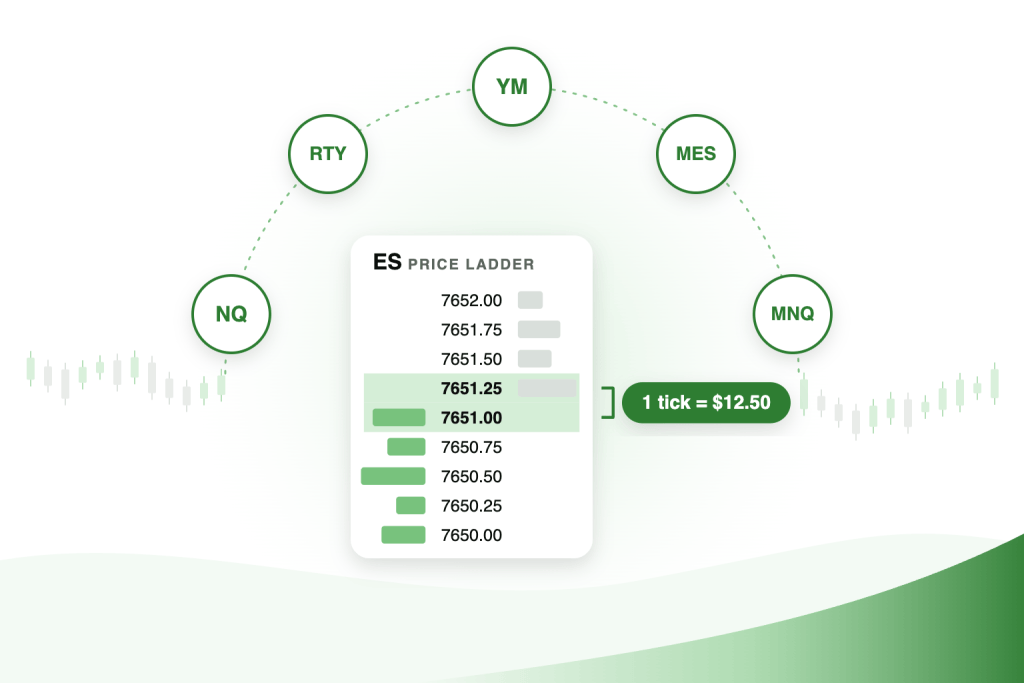
Futures Margin Explained: Day-Trade Margin, Overnight Margin and Margin Calls
Trading Education ·

Futures margin is a deposit you keep with your broker while a position is open, a performance bond rather than a loan or a down payment. CME Clearing sets the initial and maintenance margin for positions held overnight, your broker can require more, and many brokers set a lower day-trade margin for positions closed within the same session. If losses take your account below the maintenance level, you face a margin call or forced liquidation, and the surest way to avoid one is to size each trade by the dollars at risk to your stop, not by the margin the broker allows.
This guide explains how futures margin works, how day-trade and overnight margin differ, how a margin call happens step by step, and how to keep one from happening to you. For the risk side of the same question, see our guide to position sizing and stop losses.
Margin in futures is a performance bond
In stocks, margin is borrowed money: you pay part of the price and the broker lends you the rest. Futures margin works differently. CME describes it as the amount you must deposit and keep on hand with your broker when you open a position, and stresses that it is not a down payment and you do not own the underlying asset (CME Group, Margin: Know What’s Needed). The CFTC calls futures margins performance bonds designed to make sure traders can meet their obligations (CFTC, Economic Purpose of Futures Markets).
Because nothing is borrowed, you pay no interest on futures margin. But a small deposit controls a large position. CME puts futures margin at typically 3% to 12% of a contract’s notional value, compared with up to 50% for stocks bought on margin (CME Group). With E-mini S&P 500 futures trading near 7,650 on November 2, 2026 (CME Group quote), one ES contract at $50 per point controlled about $382,500 of index exposure, and one Micro E-mini S&P 500 (MES) about $38,250.
Initial margin and maintenance margin
- Initial margin is the amount CME Clearing requires to open a position. Your broker may collect more than that minimum.
- Maintenance margin is the minimum your account must hold at all times while the position is open.
CME’s own course material says maintenance margin is typically 80% to 90% of initial margin, varying by broker (CME Group, Position and Risk Management). The gap between the two is your cushion: once your account falls below maintenance, you are no longer allowed to simply wait for the trade to come back.
Day-trade margin and overnight margin
The exchange’s initial and maintenance levels apply to positions you hold past the end of the trading day. For positions opened and closed within the same session, many brokers set their own, lower day-trade margin. CME notes that brokers require more margin for positions held into the next trading day than for positions opened and closed within the same day (CME Group).
Three things follow from that:
- Day-trade margin is a broker policy, not an exchange rule. It differs from broker to broker, and a broker can raise it, sometimes without notice, when markets get volatile.
- It has a deadline. Each broker sets a cutoff before the daily close when any position still open must meet full overnight margin. If your account cannot cover it, the broker can close the position for you. Find your broker’s cutoff time and write it down.
- It lowers the deposit, not the risk. Day-trade margin lets you open more contracts with the same cash. Each point still costs the same: $50 on ES, $20 on NQ.
Your account is marked to market every day
At the end of each trading day, every open position is valued at the day’s settlement price. Gains are credited to your account and losses debited, in cash, that day (CFTC). Unlike a stock you can hold through a drawdown without topping up, a losing futures position draws cash from your account every day it loses.
Example: you hold one ES long overnight and the contract settles 20 points lower than the previous settlement. That is 20 × $50 = $1,000, taken out of your account balance that evening, whether or not you close the trade.
How a margin call happens, step by step
The figures below are made up to keep the arithmetic simple. They are not CME’s current margin levels; check your broker’s margin table for those.
Say one ES needs $25,000 initial margin and $22,000 maintenance margin to hold overnight, and you have $30,000 in your account:
- You buy one ES and hold it overnight. Your account holds $5,000 more than the initial requirement.
- Over two sessions, ES falls 170 points. At $50 per point, that is $8,500 marked against you, and your account drops to $21,500.
- That is below the $22,000 maintenance level, so you get a margin call. CME’s lesson notes that a margin call requires you to bring the account back up to the initial level, here $25,000, not just to maintenance (CME Group). You would need to deposit $3,500 or close the position.
- If you do not, the broker can reduce or liquidate the position, and many brokers monitor margin in real time and act immediately (CME Group).
Notice what went wrong. The trade had no stop that fit the account. Blueville’s futures setups use a 5-point stop plus an entry slippage buffer of up to 3 points, so one ES can lose at most 8 × $50 = $400. That is more than 1% of $30,000, $300, so a trader following that rule would have used 7 MES instead, risking $280, and been out after 8 points instead of sitting through a 170-point drop. The margin call was the result of a sizing decision made at entry.
Margin requirements change with the market
Margin is not fixed. When daily price moves become more volatile, clearinghouse methods can raise margin requirements, and they can lower them again when conditions calm down (CME Group; CME Group, Understanding Margin Changes). An increase applies to positions you already hold. A trade that met margin comfortably on Monday can be short of it on Wednesday without moving against you at all.
How to avoid a margin call
- Size by stop, not by margin. Decide your dollar risk per trade, divide it by the stop plus the slippage buffer in points times the dollars per point, and round down. The answer is your contract count, even if the broker would let you hold far more. Our futures position size calculator does the arithmetic.
- Use micro contracts when one E-mini is too big. MES and MNQ are one-tenth the size of ES and NQ, so they let you keep the stop and the slippage buffer and size down instead. Our guides to MES and NQ and MNQ cover both.
- Keep excess cash in the account. If the margin on your open positions uses most of your balance, a normal pullback or a margin increase is enough to trigger a call.
- Know the cutoff. If you trade on day-trade margin, close or reduce before your broker’s deadline, or make sure the account already covers full overnight margin.
- Plan around scheduled events. Holding through a CPI release or an earnings report from a large Nasdaq company means accepting a move larger than usual, and slippage beyond your stop. Reduce size before the event, not after.
- Never add to a loser to “average down.” Each added contract increases both the margin required and the loss per point, at the moment your cushion is shrinking.
Hedging can also change your margin picture. Our guide to hedging an options portfolio with futures covers how futures and options positions interact.
How Blueville approaches futures risk
Blueville Capital’s Futures Add-On sends live futures alerts during the overnight and morning sessions, with setup reviews and text support while the session runs. Every ES setup uses a 5-point stop and a slippage buffer of 0.25 to 3 points on the entry’s limit price, and the other indexes are set to the same dollars per contract, so you can size each one to your own account before you take it. The Add-On is booked per session and open to members and non-members, and Blueville suggests a portfolio of $25,000 or more, with $50,000 or more ideal.
Frequently asked questions
Who sets futures margin?
CME Clearing sets the initial and maintenance margin for each contract. Your broker must collect at least that much for overnight positions and can require more. Day-trade margin, for positions closed the same session, is set by each broker.
Do I pay interest on futures margin?
No. Futures margin is a performance bond, not borrowed money, so there is nothing to pay interest on. Your broker’s account terms decide whether you earn interest on the cash you hold there.
Can margin requirements change while I am in a trade?
Yes. Exchanges raise margin when markets become more volatile and lower it when they calm, and brokers can change their own day-trade margin too. A change applies to positions already open.
What happens if I cannot meet a margin call?
You can deposit more cash or close part or all of the position. If you do neither, your broker can liquidate the position, often immediately and at the current market price, and you remain responsible for any loss beyond your account balance.
Do micro futures need less margin?
Yes. Micro E-mini contracts are one-tenth the size of the E-minis, and their margin requirements are lower to match. Check your broker’s table for the exact figures.
Conclusion
Futures margin is a deposit, not a loan, and its job is to make sure you can cover your losses day by day. Day-trade margin lowers the deposit for positions closed before the close, but it changes nothing about how much each point costs you. Size every trade by its stop plus the slippage buffer, use micro contracts when one E-mini is too big, keep spare cash in the account and know your broker’s cutoff, and margin calls stop being a risk you think about. If you want live futures setups in the overnight and morning sessions, with someone reviewing them as they happen, see the Futures Add-On on our Services page.
Educational content only, not investment advice. Futures trading involves substantial risk of loss, including losses greater than your initial deposit, and is not suitable for every investor. Blueville Capital LLC is not a registered broker or financial advisor.
Free weekly email
Every alert, every Friday
The Weekly Alert Report: every alert we sent that week, winners and losers, with the high each one reached.