Futures Tick Values for ES, NQ, RTY, YM and the Micros: Sizing Stops in Dollars
Trading Education ·
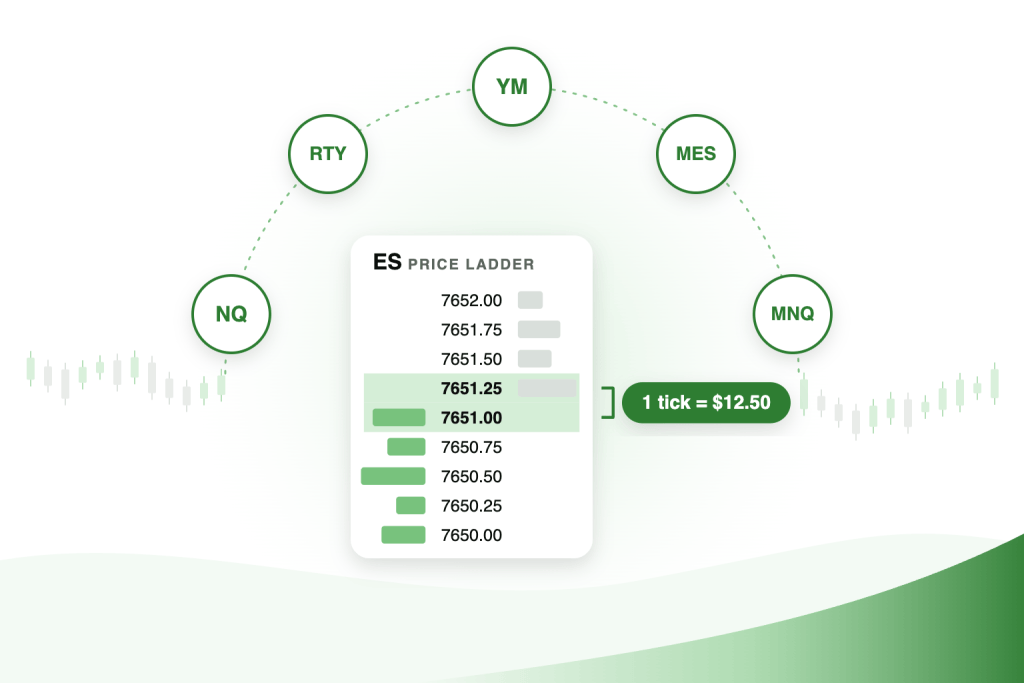
A futures tick value is the contract’s smallest price move multiplied by its dollar multiplier. One tick is worth $12.50 on ES, $5.00 on NQ, $5.00 on RTY and $5.00 on YM, and the Micro E-mini versions are one-tenth of that: $1.25 on MES and $0.50 on MNQ, M2K and MYM. To turn a stop into dollars, multiply the points at risk (the stop plus any entry slippage) by the contract’s dollars per point and by the number of contracts.
This guide gives the numbers for all eight U.S. equity index futures most retail traders use, shows the conversion from points to dollars with worked examples, and shows how to choose a contract count with a fixed 5-point stop and up to 3 points of entry slippage. All contract figures come from CME Group’s contract specifications, linked in the table.
Tick values for ES, NQ, RTY, YM and their micros
| Contract | Index | Dollars per point | Minimum tick | Tick value |
|---|---|---|---|---|
| ES (E-mini S&P 500) | S&P 500 | $50 | 0.25 | $12.50 |
| MES (Micro E-mini S&P 500) | S&P 500 | $5 | 0.25 | $1.25 |
| NQ (E-mini Nasdaq-100) | Nasdaq-100 | $20 | 0.25 | $5.00 |
| MNQ (Micro E-mini Nasdaq-100) | Nasdaq-100 | $2 | 0.25 | $0.50 |
| RTY (E-mini Russell 2000) | Russell 2000 | $50 | 0.10 | $5.00 |
| M2K (Micro E-mini Russell 2000) | Russell 2000 | $5 | 0.10 | $0.50 |
| YM (E-mini Dow, $5) | Dow Jones Industrial Average | $5 | 1.00 | $5.00 |
| MYM (Micro E-mini Dow) | Dow Jones Industrial Average | $0.50 | 1.00 | $0.50 |
ES, NQ, RTY and their micros are listed on CME; YM and MYM are listed on CBOT, part of the same group. CME’s Micro E-mini FAQ confirms that each micro is one-tenth the size of its E-mini. These are the outright tick sizes; calendar spreads between contract months trade in smaller increments. Exchanges can change specifications, so confirm them on CME’s pages before you trade.
Points, ticks and dollars
A point is a one-unit move in the index price, say from 7,650.00 to 7,651.00 on ES. A tick is the smallest move the contract can make. ES and NQ move in quarter points, so one point is four ticks. RTY moves in tenths, so one point is ten ticks. YM moves in whole points, so a point and a tick are the same thing.
That is why “10 ticks” means different amounts on different contracts. Ten ticks on ES is 2.5 points ($125); ten ticks on RTY is 1 point ($50); ten ticks on YM is 10 points ($50). Work in points and dollars per point, and the confusion goes away.
The formula is the same for every contract:
Dollar risk = (stop + entry slippage, in points) × dollars per point × number of contracts
Converting stops into dollars
Blueville’s futures setups use a 5-point stop on every contract. Entries are limit orders, and a slippage buffer of 0.25 to 3 points is added to the entry’s limit price when the order is placed, so the entry can fill up to 3 points beyond the alert price while the stop stays where it was. The most a trade can risk is 5 + 3 = 8 points. Profit exits are limit orders at the target and carry no slippage. Here is what that maximum costs, per contract:
- ES, 5-point stop plus 3 points of slippage: 8 × $50 = $400. On MES: 8 × $5 = $40.
- NQ, 5-point stop plus 3 points of slippage: 8 × $20 = $160. On MNQ: 8 × $2 = $16.
- RTY, 5-point stop plus 3 points of slippage: 8 × $50 = $400. On M2K: 8 × $5 = $40.
- YM, 5-point stop plus 3 points of slippage: 8 × $5 = $40. On MYM: 8 × $0.50 = $4.
With the smallest buffer, 0.25 points, the same trades risk 5.25 points: $262.50 on ES, $105 on NQ, $262.50 on RTY and $26.25 on YM. The entry itself comes from the setup, at a supply or demand zone; our guide to supply and demand zones covers how those zones are drawn.
How many contracts to trade
Turn the formula around and it tells you your size:
Contracts = dollar risk budget ÷ ((stop + entry slippage, in points) × dollars per point), rounded down
Say you trade a $50,000 account and risk 1% per trade, $500, with the 5-point stop and the full 3 points of slippage, 8 points in all:
- ES. One ES risks 8 × $50 = $400, so 1 ES fits ($400). In micros, the same position is 10 MES.
- NQ. One NQ risks 8 × $20 = $160. $500 ÷ $160 = 3.1, which rounds down to 3 NQ ($480), the same position as 30 MNQ.
- RTY. One RTY risks 8 × $50 = $400, so 1 RTY fits ($400), or 10 M2K.
- YM. One YM risks 8 × $5 = $40. $500 ÷ $40 = 12.5, which rounds down to 12 YM ($480), or 120 MYM.
Each E-mini is ten micros, so the micro count is the same position in smaller pieces. Micros matter when even one E-mini is more than the budget. At 1% of $30,000, $300, one ES at 8 points ($400) doesn’t fit, but 7 MES ($280) do. The stop stays at 5 points; the contract count is what changes. Our futures position size calculator does this arithmetic for any account, risk and slippage.
Compare contracts in dollars, not points
The same 8 points cost very different amounts on each contract: $400 on ES and RTY, $160 on NQ and $40 on YM. The indexes also trade at very different price levels, so a point on one is not the same size of move as a point on another. When you choose between instruments for the same idea, compare what the stop costs in dollars per contract, and how many contracts fit your budget. Our comparisons of NQ and ES, YM and MYM and RTY and M2K go deeper on each contract’s character.
Count the slippage buffer in your risk
Slippage is easy to leave out because it isn’t part of the stop. But the buffer on the entry’s limit price lets the entry fill up to 3 points beyond the alert price while the stop stays put, so the distance to the stop can grow from 5 points to 8. On one ES, a 3-point buffer adds $150 to the $250 a 5-point stop costs, for $400 in all. Always size from the stop plus the buffer, not the stop alone. The profit exit is a limit order at the target, so it adds nothing. A stop order can still fill beyond its price in a fast or thin market, overnight or around 8:30 a.m. economic releases, so keep that and your commissions in mind too.
Notional value: what one contract controls
Tick value tells you what each move costs; notional value tells you how much exposure you hold. Notional is the index price times the multiplier. With ES near 7,650 on November 2, 2026 (CME Group quote), one ES controlled about $382,500 of S&P 500 exposure and one MES about $38,250. Tick values stay fixed as the index moves; notional value rises and falls with it.
Common mistakes
- Mixing up dollars per point. ES and RTY are both $50 per point; NQ is $20; YM is $5. Moving from ES to NQ without adjusting size changes your risk.
- Treating micros as low risk. A micro loses the same percentage as an E-mini on the same move. It is a smaller position, not a safer one, and ten micros are one E-mini.
- Sizing by margin. The margin your broker requires says nothing about where your stop is. Our guide to position sizing and stop losses covers the same principle for options.
- Leaving the slippage buffer out of the risk. A 5-point stop with a 3-point buffer can lose 8 points, not 5.
How Blueville fits in
Blueville Capital’s Futures Add-On sends live futures alerts during the overnight and morning sessions, with setup reviews and text support while the session runs, and every setup uses the 5-point stop and an entry slippage buffer of 0.25 to 3 points, so you can choose between E-mini and micro contracts for your own account. It is booked per session and open to members and non-members, and Blueville suggests a portfolio of $25,000 or more, with $50,000 or more ideal.
Frequently asked questions
What is the difference between a tick and a point in futures?
A point is a one-unit move in the index price. A tick is the smallest move the contract allows: a quarter point on ES, NQ and their micros, a tenth of a point on RTY and M2K, and one full point on YM and MYM.
Are micro futures exactly one-tenth of the E-minis?
Yes. MES is $5 per point against $50 on ES, MNQ $2 against $20 on NQ, M2K $5 against $50 on RTY, and MYM $0.50 against $5 on YM. Ten micros move exactly like one E-mini.
Does the tick value change when the index price changes?
No. The multiplier is fixed, so a tick on ES is always $12.50. What changes with the index level is the notional value of the contract and, usually, how many points the market moves on an ordinary day.
Which index futures contract has the smallest tick value?
MNQ, M2K and MYM all have a tick value of $0.50. MES is $1.25.
Conclusion
Every futures stop comes down to one line of arithmetic: the stop plus the slippage buffer in points, times dollars per point, times contracts. Learn the dollars per point for the contracts you trade, size from the stop plus the slippage buffer instead of your margin, and use micros when one E-mini is more than your budget. If you want live futures setups in the overnight and morning sessions, with someone reviewing them as they happen, see the Futures Add-On on our Services page.
Educational content only, not investment advice. Futures trading involves substantial risk of loss and is not suitable for every investor. Blueville Capital LLC is not a registered broker or financial advisor.