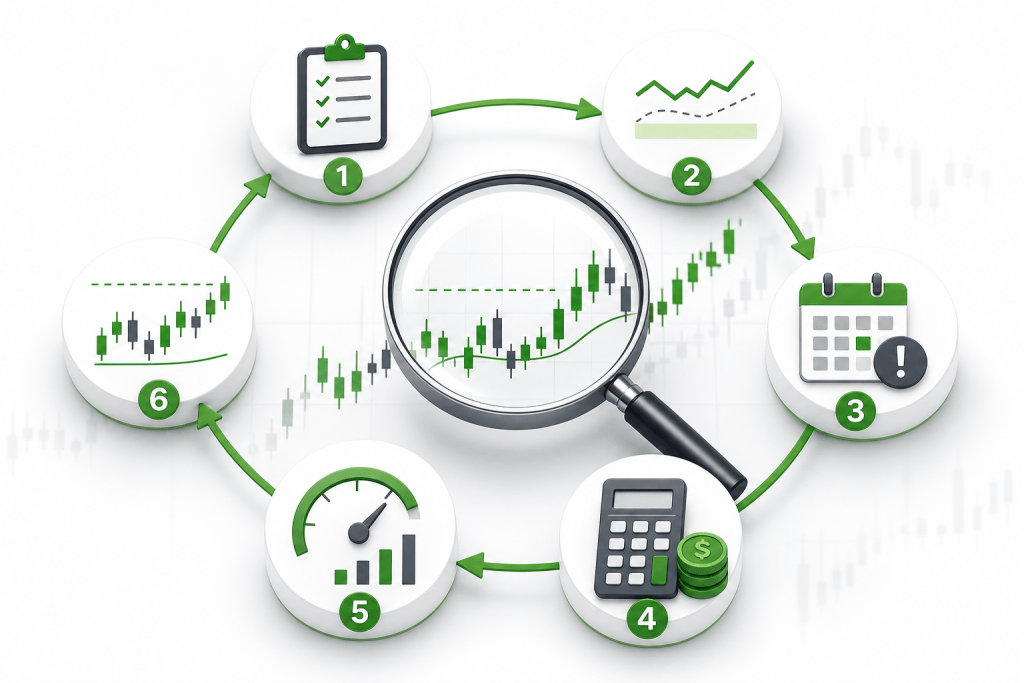
A stock picking service gives you a short list of recommendations, usually a few new stocks per month, plus research tools or rankings. Whether it is worth paying for depends on three things: total cost after renewal, a verifiable track record against the S&P 500, and the time you can spend managing positions.
Most reviews rank these services by their own headline returns. That is the wrong starting point. The failure pattern is almost always the same: you read a marketing number, subscribe at an introductory rate, and never check what the service costs in year two or whether the picks beat an index fund over the same dates.
This article covers one narrow problem. It does not ask which trading approach is best. It gives you a repeatable way to audit any stock picking service before you pay. If you want the broader argument for index-focused alerts over single-stock picks, read this breakdown of the best stock alert service approach and how it compares. Here, you work through six steps in order.
Step 1: What Does a Stock Picking Service Actually Give You?
A stock picking service delivers curated recommendations: specific tickers, a reason for each, and a cadence, usually monthly. A research toolkit delivers screens, scores, and lists, and leaves the decisions to you. Access and opportunity are not the same thing, and neither is a pick list the same as a process.
Three widely reviewed services show the split.
- Motley Fool Stock Advisor provides two new stock recommendations per month plus a "Top 10" list of timely buys and foundational picks. It recommends holding a diversified portfolio of 50 or more picks for at least five years. Its terms of service state that some content may be generated by artificial intelligence, so check what is written by an analyst and what is not.
- Seeking Alpha Alpha Picks also delivers two monthly recommendations, selected by a proprietary quantitative scoring system that ranks companies on value, growth, profitability, and momentum. It publishes a documented trade log with buy and sell signals.
- Zacks Premium is closer to a toolkit than a pick service. You get the Zacks Rank, which scores stocks on earnings estimate revisions, along with screening tools and focus lists. The Zacks Rank #1 list is rebalanced daily, so the work of choosing and sizing stays with you.
Analyst-driven picks, quant-scored picks, and screening tools demand different things from you. Decide which of the three you are buying before you compare prices. Many stock picking service reviews blur this line and compare a monthly pick list directly against a daily screener, which tells you nothing.
Step 2: What Does a Stock Picking Service Really Cost After Year One?
Price the service over at least three years, not the first month. Introductory rates often differ from renewal rates, and the gap is where most buyers get surprised. Do this before you enter a card number:
- Find the introductory price and the renewal price. Look for both on the checkout page and in the terms. If the renewal price is not stated, treat that as a cost you cannot yet calculate.
- Multiply across three years. Use the renewal figure for years two and three. A cheap first year followed by a pricier renewal is a different product from a flat-rate subscription.
- Read the refund and trial terms. Do not assume a guarantee exists. In the reviewed set, Seeking Alpha Alpha Picks fees are generally non-refundable, while Zacks Premium advertises a 90-day money-back guarantee. Confirm the current terms on each provider's own site, since they change.
- Compare against market norms. A study of 437 financial newsletters found that 71% of products that disclose pricing start at a low monthly rate, according to newsletters.markets' 2026 study. The median starting price for financial research subscriptions is $30 per month, based on 69 priced publications.
- Check the tier you actually need. A budget-tier entry price does not tell you what the pick list costs. Motley Fool Stock Advisor and Zacks Premium sit in the budget tier, while Alpha Picks sits at a premium tier. Confirm which plan includes the picks themselves.
A service priced at double the median needs to show picks that beat the index by a clear margin after fees, not just a strong marketing page. If Motley Fool Stock Advisor is the one you are weighing, apply this same renewal test to it before you decide whether it is worth the renewal price.
Step 3: Can Retail Investors Actually Beat the S&P 500 With Stock Picks?
Most cannot, and that is the benchmark every service's claims must be read against. Read every service's claims against that benchmark.
Start with professionals. SPIVA scorecard data shows that 79% of active large-cap mutual funds failed to beat their benchmark index in 2025, per Exent's summary of the scorecard. If full-time managers with research teams lag the index, a two-picks-per-month list deserves a skeptical read, and one good stretch of returns proves little.
Retail behavior makes it harder. A Berkeley study of 66,465 retail households published in The Journal of Finance found that the most active traders earned an 11.4 percent annual return, well behind the 17.9 percent market return. Lambda Finance reports that only about 10% of retail investors managed to outperform the S&P 500 on a consistent basis, according to its 2026 analysis.
No stock picking service can guarantee you beat the S&P 500, and none of these services is an exception. The honest framing is narrower: a pick list may help you choose better than you would alone, but only if you follow it with discipline and the picks outperform the index net of cost.
That is the same logic behind index-focused alert services versus single-stock picks. Index instruments remove the single-stock selection problem the data above describes.
Step 4: How to Check a Stock Picking Service’s Track Record
A track record is a claim until you can reproduce it. Treat every marketing return as unaudited, then run it through four checks before you let it influence a purchase.
- Match the dates. Ask for the return of the service's picks and the S&P 500 over the same start and end dates. A "since inception" figure with no benchmark beside it tells you nothing. The SPIVA data above, where 79% of active large-cap funds trailed the index, is the standard you hold the service to.
- Strip out the top winners. Motley Fool Stock Advisor's marketing performance figure of +950% is heavily influenced by a few extreme winners such as Amazon and Netflix. Remove the best three or four picks and recalculate. If the average collapses, the result depends on outliers you cannot count on repeating.
- Define what counts as a recommendation. Does the service count every pick it published, or only the ones it still lists? Does it count the monthly picks, the Top 10 list, or both? A track record that quietly drops losers is not a track record.
- Check the holding period. Seeking Alpha Alpha Picks documents a trade log with clear buy and sell signals, and its win rate rises from 47.6% under one year to 77.6% at one to three years. A pick that needs three years to work is a different commitment from one you can judge in a quarter.
Done well, this audit is slow and unglamorous. It also rules out most of the stock picking service reviews you will find, because they repeat the provider's own headline numbers without testing them.
Step 5: Which Is the Best Stock Picking Service for Your Style?
There is no single best stock picking service, only a best fit for your holding period and the time you can give it. The best stock picking service for long-term investors is the one whose pick style matches a multi-year hold, so sort by style first, then by cost.
| Pick style | Who it suits | Time commitment |
|---|---|---|
| Analyst-driven picks (Motley Fool Stock Advisor) | Long-term investors and beginners who want a short, curated list and can hold for at least five years | Low per month, but you build and maintain a portfolio of 50 or more picks |
| Quant-scored picks (Seeking Alpha Alpha Picks) | Investors who want a rules-based, documented trade log and can hold one to three years or longer | Moderate: two new picks monthly, plus following buy and sell signals |
| Screening-based research (Zacks Premium) | DIY and more active investors who want tools, not a pick list | Highest: the Zacks Rank #1 list rebalances daily, so you choose and manage the trades |
Quantitative picks differ from analyst recommendations in what you are trusting. An analyst pick asks you to trust a person's judgment and thesis. A quant pick asks you to trust a scoring model and its rules. Neither removes the benchmark problem from Step 3.
For beginners, the analyst list is the easier fit, but a 50-pick target is a heavy build for a small account, so start with the most recent picks and add slowly. For active traders, a screening toolkit gives more control but demands more of your day. If you find you want daily setups rather than monthly stock picks at all, that is a different product category, covered after Step 6.
Step 6: Are Stock Picking Services Worth It for the Time You Have?
Whether stock picking services are worth it depends less on the subscription fee than on the hours you will spend acting on the picks. A rough estimate: at one to two hours per pick for research, entry, and tracking, two picks a month comes to 4 to 8 hours monthly, or about 48 to 96 hours a year, before any rebalancing.
Take a service that issues two new picks per month, such as Motley Fool Stock Advisor or Alpha Picks. Each month you must research the thesis, decide a position size, place the order, and record it. Then you monitor existing holdings and decide when to trim or exit. After a year you hold up to 24 positions from that one service. Recommending 50 or more picks over time means the portfolio keeps growing, and each position needs rebalancing against the rest.
The failure pattern is almost always the same: you buy the first few picks, stop following new ones, and end up with a partial portfolio the service never intended. That matters because the evidence on retail investors shows the most active traders earned 11.4 percent a year against a 17.9 percent market return.
A stock picking service is worth it only if three conditions hold. The total cost after renewal is modest next to your portfolio, the track record survives Step 4, and you will follow every pick for the intended holding period. If you cannot commit to all three, an index fund costs less and asks less of you.
When an Index Options Alert Service Fits Better Than Stock Picks
If you want daily index-based options setups instead of two stock picks a month, you are shopping in a different category. A stock picking service asks you to hold names for years. An options alert service asks you to act on defined setups within a single session, which is a different risk profile and a different skill.
Blueville Capital is the second kind of product, not a stock picking service. Its membership provides daily index and stock options trade setups on SPX, RUT, SPY, and IWM built on supply and demand analysis, with live alerts, market data, and performance tracking. The Base Membership costs $295.95 per month, and one-on-one options classes are available for traders who want instruction rather than signals. An spx options trading service like this suits you only if you already understand options and can act inside market hours.
Access and opportunity are not the same thing here either. Options can lose their full premium. Profit targets are goals, not guarantees. The buy-and-hold discipline in Steps 1 through 6 does not carry over.
Prices and plan limits verified as of November 2026.
FAQs
Are stock picking services worth it for beginners?
They can be, if you pick a long-hold analyst list and follow every recommendation. The risk for beginners is partial follow-through: buying a few picks, ignoring the rest, and holding a lopsided portfolio. Run the cost and track record checks first, and compare the result with a plain index fund before you subscribe.
Can a stock picking service guarantee beating the S&P 500?
No. The benchmark evidence shows most active strategies lag the index. A service can publish strong past results, but past results do not guarantee future ones. Treat any guarantee of outperformance as a red flag.
How do I find out what a stock picking service really costs after the first year?
Find the renewal price in the checkout flow or terms, not the landing page. Multiply it across three years and add any add-on fees for the tier that includes the picks. If the provider does not state the renewal price anywhere you can find, email support and keep the reply.
What is the difference between a stock picking service and a stock trading alert service?
A stock picking service issues a few recommendations a month meant to be held for years. A trading alert service sends setups with entry and exit targets, often for options, meant to be acted on within a day or week. The first suits investors. The second suits active traders with defined risk and time during market hours.
Do stock picking services offer refunds or free trials?
Terms vary and change, so check each provider's own site before paying. In the reviewed set, Alpha Picks fees are generally non-refundable, while Zacks Premium advertises a 90-day money-back guarantee. Save a copy of the terms at the time you subscribe.
How many stocks do I need to buy to follow a picking service properly?
It depends on the service. Motley Fool Stock Advisor recommends holding a diversified portfolio of 50 or more picks for at least five years. A service issuing two picks a month adds roughly two positions monthly, so decide your position sizing before you start.
Conclusion
A stock picking service is worth paying for only if its cost after renewal is modest, its track record holds up against the S&P 500 over matched dates once outliers are removed, and you will follow every pick for the full holding period. Most retail investors do not beat the index, so the burden of proof sits with the service.
Before you subscribe, price the service over three years, rebuild its track record without the top few winners, and write down how many hours a month you will spend managing the picks. If any of those numbers fail, index funds ask less of you and cost less.
Free weekly email
Every alert, every Friday
The Weekly Alert Report: every alert we sent that week, winners and losers, with the high each one reached.