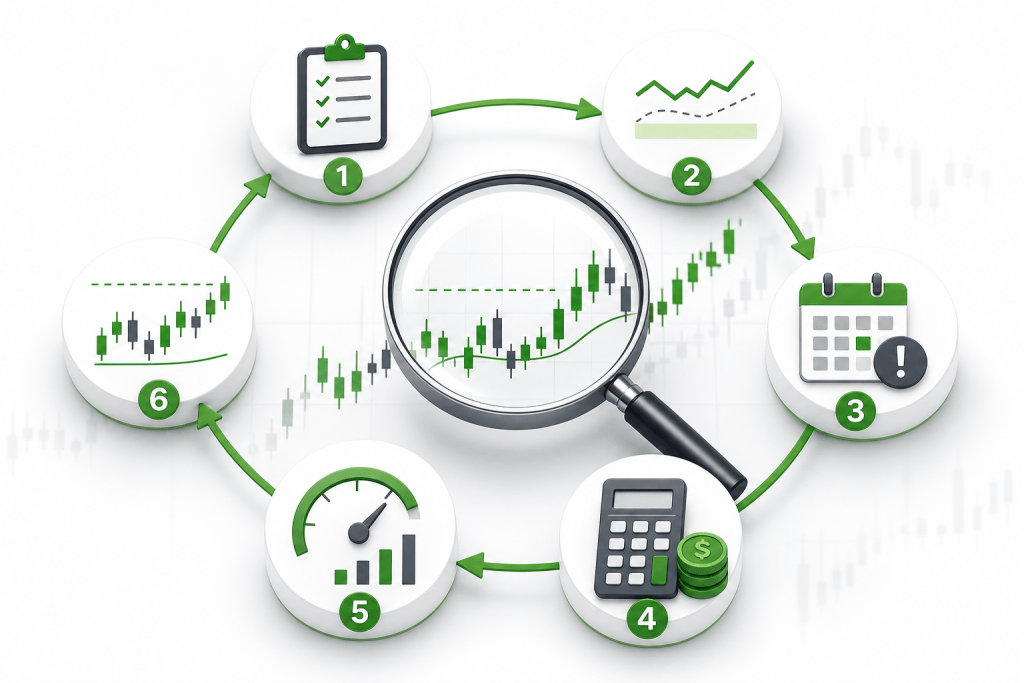
Learn from an options expert whose record you can check, whose risk rules are written down, and who shows losing trades as plainly as winning ones. Avoid anyone who promises guaranteed or outsized returns, hides misses, or pushes you to pay before you can verify anything.
The rest of this guide turns that into checks you can run on any educator, trading room or alert service, including ours.
What makes an options expert worth learning from?
Credibility comes from things you can verify, not from follower counts. Before you trust anyone’s options calls or courses, look for four things:
- A complete record. Every trade, dated, misses included, with a plain explanation of how results are measured.
- Written risk rules. How much they risk per trade, where the stop sits, and what they do after a losing streak.
- A method you can explain. After a few lessons you should be able to say in a sentence or two why a trade was taken.
- Teaching that builds independence. A good teacher wants you able to find and judge setups yourself, whether or not you keep paying.
Fame is not on that list. A large audience shows that someone markets well. It says nothing about whether their method holds up over hundreds of trades.
Why famous examples are a weak guide
Pitches for courses and trading groups often borrow famous names, and the numbers lose their context along the way. You’ll see it said that Warren Buffett made $4.9 billion selling puts in 2008. Berkshire Hathaway’s own 2008 shareholder letter tells a fuller story. The $4.9 billion was the total premium Berkshire had received on long-dated put contracts on four stock indexes, with $37.1 billion at risk and expiration dates from 2019 to 2028. At the end of 2008, Berkshire also carried a $10 billion liability on those contracts, which meant a $5.1 billion mark-to-market loss on paper.
Those were 15- to 20-year index puts written by a company with enormous capital, not a strategy a retail account can copy. The lesson for vetting experts is simple: when someone quotes a headline figure, find the primary source and read the risk side too.
Step 1: Learn the core strategies before you pick a teacher
You can’t judge a teacher until you know the basics they’re teaching. Free courses cover them well, including those from the Options Industry Council and the Cboe Options Institute. Before you pay anyone, make sure you can explain:
- long calls and puts, where the most you can lose is the premium you paid;
- covered calls and cash-secured puts;
- vertical spreads, where both the maximum gain and the maximum loss are set at entry;
- how time decay and implied volatility change an option’s price.
If you’re still weighing whether to learn alone or with help, our guide to choosing between DIY and guided options education walks through the trade-offs.
Step 2: Check the record before the personality
A track record is only useful if it’s complete and you understand what it measures. Ask these questions about any record you’re shown:
- Does it include every call, or only highlights? Screenshots of winners prove nothing on their own.
- Is each trade dated and timed, so it can be checked against market prices?
- Is a result the price the trade was closed at, or the best price it reached afterwards? Both are used, but they aren’t the same thing, and the best price will always look better.
- Are percentages shown with position size? A 300% gain on a small lotto and a 20% loss on a full-size position tell very different stories.
We hold our own record to the same test. Our page on how we track every alert explains that each result is the best price reached after the alert, not a closed trade or anyone’s profit, and every alert is listed, misses included.
Step 3: Test the expert’s risk rules
Ask any expert three questions: how much of the account do you risk on one trade, how much across all open trades, and what do you do after three losses in a row? A credible answer is specific and written down. “It depends” with nothing behind it is a warning sign.
One rule of thumb you’ll see is the 3-5-7 rule. Its common form caps risk at 3% of the account on any one trade and 5% across all open trades. Writers define the 7 differently, so treat the per-trade cap as the useful part and compare each expert’s sizing against it.
Then check the rules against the calls themselves. If a mentor’s trades routinely risk far more than the rule they teach, the rule is marketing. Our article on position sizing and stop losses shows how to work out the size yourself.
Step 4: Spot the red flags of options gurus
The SEC’s investor education site lists red flags of investment fraud that apply directly to options promoters: claims that sound too good to be true, “guaranteed” returns, a likeable “halo” that stands in for checked qualifications, and pressure because “everyone is buying.” Add these options-specific ones:
- Winners only. Profit screenshots with no full trade list and no losing trades.
- Returns with no size or dates. “+400% this week” means nothing without the position size and the trade list behind it.
- Lifestyle selling. Cars, travel and income claims in place of a method.
- Urgency. Countdown timers, “last spots” and discounts that expire today.
- Secret systems. An indicator or formula you’re not allowed to understand can’t be tested.
Any one of these is a reason to slow down. Two or more is a reason to walk away.
Step 5: Match the format to what you need
Mentors, trading rooms, alert services and self-study solve different problems, so decide what you want to learn or hand off before you compare prices.
| Format | What you get | Main risk |
|---|---|---|
| Mentorship | Method teaching and feedback on your own trades | Teaching without a record you can check |
| Paid trading room | Live commentary and shared trade ideas | Copying calls without understanding them |
| Alert service | Specific setups with entries and exits | Following signals you can’t evaluate |
| Self-study | Free courses, books and paper trading | Slow progress with no feedback |
If a mentor is what you need, our guide to picking a trading mentor worth paying covers the questions to ask. For alerts, see how to choose an options trading alert service.
Step 6: Audit ten calls before you commit
Treat your first weeks with any expert as a test. Paper trade the calls if you can, and judge each one on four points:
- The reason. Note the underlying and why the trade was taken. If no reason is given, it can’t be tested.
- The payoff. Use your broker’s analysis tool to find the maximum loss and the break-even before entry, and check that the loss fits the risk rule from Step 3.
- The exit plan. Check that a profit target and a stop were set before entry.
- The follow-through. Note whether the trade was closed early, rolled or left to expire, and whether that matched the plan.
After ten calls you’ll have evidence instead of impressions. If the process holds up, keep going. If it doesn’t, you’ve saved the fee.
Where Blueville Capital fits
Blueville Capital sends live index options alerts on SPX, SPY, QQQ and RUT with defined entries and exits, built on supply and demand zones, and members get strategy support in our Slack community. Every alert is published in our weekly alert record, winners and misses alike, so you can run the audit above on us too.
FAQs
Does anyone actually make money trading options?
Some traders do, but outcomes vary widely and losses are common, especially with large position sizes. That’s why the checks above focus on risk rules and complete records rather than on any one trader’s best results.
How can I tell if an Instagram or TikTok options trader is legitimate?
Ask for a full, dated trade list that includes losses, and for their written risk rules. Then check a few calls against market prices for the same day. If they only share screenshots, won’t show losing trades, or push a paid group with a deadline, treat the account as marketing.
What’s the difference between an options mentor and an alert service?
A mentor teaches you a method and reviews your own trades, so the goal is independence. An alert service sends specific setups to act on. Some traders use both: alerts to see a method applied in live markets, and mentoring to learn to find the setups themselves.
Is a paid options trading room worth it?
It can be, if its record is complete, its risk rules are written down and you have time to follow it during market hours. Run the ten-call audit first. If a room can’t pass it, no price is low enough.
Conclusion
The best options expert to learn from is one you can check: a complete record, written risk rules, a method you can explain, and no promises. Learn the basics from free sources, trace every headline figure to its primary source, and audit ten calls before you commit to anyone.
If you want to learn the supply and demand method behind our setups one on one, Classes & Mentoring covers it in four two-hour video sessions plus 20 days of market-hours coaching.
Educational content only, not investment advice. Options and futures trading involve substantial risk of loss and are not suitable for every investor. Blueville Capital LLC is not a registered broker or financial advisor.
Free weekly email
Every alert, every Friday
The Weekly Alert Report: every alert we sent that week, winners and losers, with the high each one reached.