Supply and Demand Trading Strategy: How to Time Options Entries Like a Pro
Index Options Trading ·
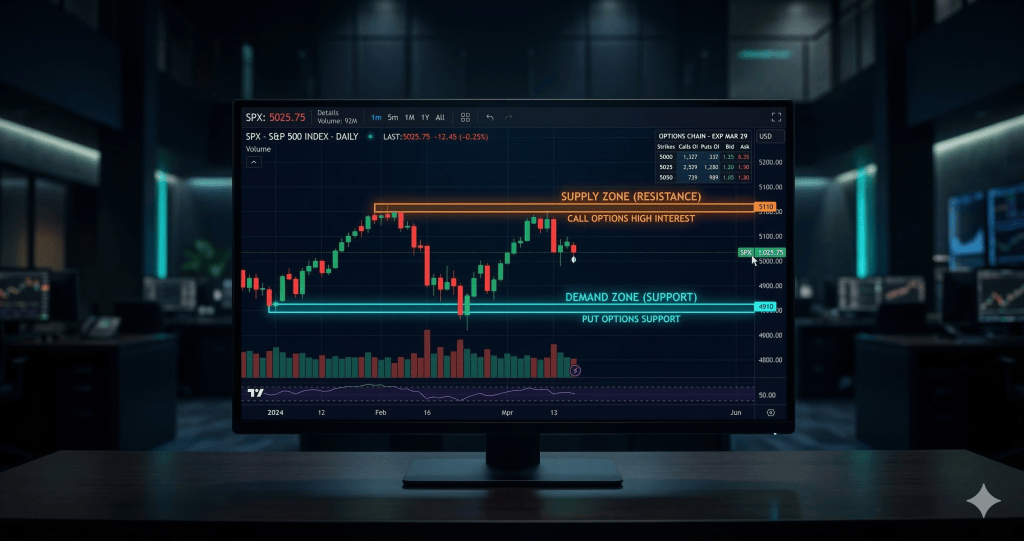
Table of Contents
- What Are Supply and Demand Zones?
- How to Identify Supply and Demand Zones on a Chart
- How to Use Zones for Options Entries
- Confluence Factors That Strengthen a Setup
- How to Manage Trades Using Zones
- Common Mistakes Traders Make With This Strategy
- How Blueville Capital Applies This Methodology Daily
- FAQs
- Disclaimer
Introduction
Most retail traders lose money not because they pick the wrong direction, but because they enter at the wrong price. They buy calls when SPX is already extended, or they buy puts right as the market bounces off a floor. Timing is everything in options trading, and supply and demand analysis is one of the most reliable ways to improve it.
This article breaks down exactly how supply and demand zones work, how to spot them on a chart, and how to use them to time entries on SPX, RUT, SPY, and IWM options. You will also see how Blueville Capital applies this methodology every trading day to generate setups targeting 50%+ profit on index options plays.
What Are Supply and Demand Zones?
Supply and demand zones are price areas on a chart where significant buying or selling activity previously occurred. These zones are not arbitrary lines. They mark the exact price levels where institutional orders were placed and, in many cases, where unfilled orders still sit.
A demand zone is a price area where buyers stepped in aggressively, causing price to move sharply upward. If price returns to that zone, those buyers are likely to step in again.
A supply zone is the opposite — a price area where sellers overwhelmed buyers, causing a sharp move downward. When price returns to that zone, sellers tend to re-engage.
These zones differ from standard support and resistance lines. Support and resistance are often drawn at single price points. Supply and demand zones are drawn as boxes or ranges, reflecting how institutional orders are filled across a range, not at one exact price.
How to Identify Supply and Demand Zones on a Chart
The Base-and-Move Pattern
You are looking for a base followed by a strong move away from that base. A base is a tight consolidation area — usually two to five candles — where price moves sideways before launching sharply in one direction. That base becomes your zone.
- Demand zone: Price drops into a tight range, consolidates briefly, then surges upward. The consolidation area is your demand zone.
- Supply zone: Price rallies into a tight range, consolidates, then drops sharply. That consolidation area is your supply zone.
Drawing the Zone
Draw the zone from the bottom of the base candle wicks to the top of the base candle bodies (for demand), or from the top of the base candle wicks to the bottom of the base candle bodies (for supply). Keep the zone tight — if you are drawing a box that spans 50 SPX points, it is too wide.
Timeframe Matters
Higher timeframe zones carry more weight. A demand zone on the daily chart will attract more institutional attention than one on a 5-minute chart. Use higher timeframe zones for direction, lower timeframe zones for precise entry timing.
How to Use Zones for Options Entries
Buying Calls at Demand Zones
When SPX, SPY, or IWM approaches a well-defined demand zone, look for a call entry. Wait for price to enter the zone and show a reaction — a rejection candle, a bullish engulfing pattern, or a strong close off the lows. That confirmation reduces the chance of entering into a zone that fails.
For SPX options, a 0DTE or 1DTE call at a daily demand zone can target 50%+ if the move is clean. The zone gives you a defined area to work with, so your stop is clear and your risk is controlled.
Buying Puts at Supply Zones
When SPX or RUT rallies into a supply zone, look for put entries. Wait for price to stall, reject, or show a bearish candle pattern at the top of the zone before entering. Supply zones on the daily or 4-hour chart are particularly useful for SPX puts because they often align with areas where the broader market has historically reversed.
Confluence Factors That Strengthen a Setup
The strongest setups occur when multiple factors align at the same price level:
- Volume at the zone — Was there a spike in volume when price originally left the zone? High volume suggests institutional participation and makes the zone more reliable.
- Higher timeframe alignment — A 15-minute demand zone sitting inside a daily demand zone is meaningful. Both timeframes pointing to the same level means you are trading with larger order flow.
- Prior reaction strength — How cleanly did price react the last time it tested this zone? Fresh zones that have not been tested since forming tend to be the strongest.
- Market structure context — Buying calls at a demand zone in an uptrend is higher-probability than doing the same in a strong downtrend. Always check the bigger picture first.
How to Manage Trades Using Zones
Setting Your Stop
Place your stop just below the demand zone (for calls) or just above the supply zone (for puts). If price closes outside the zone, the setup is invalidated. The zone itself defines your risk — you do not need a wide stop.
Targeting the Next Zone
Your profit target should be the next supply zone above (for calls) or the next demand zone below (for puts). If the next supply zone is 30 SPX points away on a 0DTE option, that move can easily produce 50% to 100%+ on the option.
Scaling Out
Consider taking partial profits at the midpoint between your entry zone and your target zone. This locks in gains while leaving part of the position open for the full move — it reduces emotional pressure and keeps you in the trade longer.
Common Mistakes Traders Make With This Strategy
- Entering too early — Jumping in the moment price touches a zone without waiting for a confirmation candle leads to repeated stop-outs.
- Drawing zones too wide — A zone spanning 40–50 SPX points is not a zone, it is a region. Tight, precise zones give better entries and cleaner stops.
- Ignoring the trend — Trading demand zones in a clear downtrend is low-probability. Always align with the broader market direction.
- Overtrading — Not every zone produces a trade worth taking. Sitting on your hands is a valid and often correct decision.
- Holding through zone breaks — If price closes below your demand zone, the setup is done. Holding and hoping turns small losses into large ones.
How Blueville Capital Applies This Methodology Daily
At Blueville Capital, supply and demand analysis is the foundation of every trade setup we share with members. Each trading day, we identify key supply and demand zones on SPX, RUT, SPY, and IWM across multiple timeframes. When price approaches those zones and the setup meets our criteria, we issue live trade alerts with specific entry areas, targets, and invalidation levels.
Every setup targets 50%+ profit on options plays. We are not chasing momentum or reacting to news — every alert is tied to a specific zone with defined risk.
Members get access to daily index and stock trade setups, live alerts, and market data. For traders who want to go deeper, our one-on-one mentoring sessions cover this methodology from scratch — how to draw zones, identify confluence, and manage positions in real time. Tiered membership options are available for portfolios from USD 5K to USD 200K+.
👉 blueville.capital
FAQs
Q: What is a supply and demand zone in trading? A: A supply and demand zone is a price area where significant buying (demand) or selling (supply) previously occurred, causing a sharp price move. These zones mark levels where institutional orders were placed and may be placed again when price returns.
Q: How do I use supply and demand zones for SPX options entries? A: Buy calls when SPX approaches a demand zone and shows a bullish reaction. Buy puts when SPX reaches a supply zone and shows a bearish rejection. The zone gives you a defined entry area and a clear stop level just outside the zone.
Q: What timeframe works best for supply and demand zone trading? A: Daily and 4-hour charts produce the most reliable zones for index options trading. Use 15-minute or 1-hour charts for precise entry timing, but always confirm that the lower timeframe zone aligns with a higher timeframe zone.
Q: How do I know if a supply or demand zone is still valid? A: Fresh zones that have not been tested since forming are generally the strongest. If a zone has been tested multiple times without breaking, it may be weakening. Also check whether the original move from the zone was accompanied by high volume.
Q: Can beginners use supply and demand analysis for options trading? A: Yes, but it takes time to learn how to draw zones accurately and read price reactions. Starting with daily charts and focusing on SPX or SPY makes the learning curve more manageable. One-on-one mentoring like what Blueville Capital offers can significantly accelerate the process.
Q: What is the difference between supply and demand zones and support and resistance? A: Support and resistance are typically single price lines drawn at obvious highs and lows. Supply and demand zones are drawn as boxes that capture the consolidation area before a strong move, reflecting how institutional orders are filled across a price range.
Q: How does Blueville Capital use supply and demand zones in its trade alerts? A: Blueville Capital identifies key supply and demand zones on SPX, RUT, SPY, and IWM each trading day. When price approaches a zone and meets the entry criteria, members receive live trade alerts with specific entry areas, targets, and invalidation levels — all targeting 50%+ profit on options plays.
Conclusion
Supply and demand analysis gives you a structured way to time options entries rather than guessing at direction. When you combine well-drawn zones with confluence factors like volume, higher timeframe alignment, and prior reaction strength, you get setups with defined risk and clear targets.
The methodology works. The challenge is applying it consistently — which is where having daily setups and live alerts makes a real difference.
👉 blueville.capital
Disclaimer: Trading options involves significant financial risk and is not suitable for all investors. Past performance does not guarantee future results. This article is for educational purposes only and does not constitute financial advice. All references to targeting 50%+ profits reflect potential setups based on historical zone analysis and are not guarantees of any specific return. Always conduct your own research and consult a licensed financial advisor before making trading decisions.