Introduction
SPX or SPY — it’s one of the first decisions every index options trader has to make. Both track the S&P 500. Both are among the most liquid options markets in the world. But they are not the same instrument, and choosing the wrong one for your account size or strategy can cost you real money.
This guide breaks down every meaningful difference between SPX and SPY options so you can make the right choice for your trading style, account size, and tax situation.
What Are SPX Options?
SPX options are listed on the CBOE (Chicago Board Options Exchange) and are based directly on the S&P 500 Index — not an ETF. Because the S&P 500 is an index and not a tradable asset, SPX options are cash-settled at expiration. No shares change hands.
Key characteristics:
- Underlying: S&P 500 Index (not a fund)
- Settlement: Cash-settled, European style
- No early assignment risk — can only be exercised at expiration
- Contract multiplier: USD 100 per point
- Expirations: Daily (Monday, Wednesday, Friday), weekly, and monthly
- Trading hours: Nearly 24-hour trading available
What Are SPY Options?
SPY options are based on the SPDR S&P 500 ETF Trust — an exchange-traded fund that holds shares of the actual S&P 500 companies. Because SPY is an ETF and not an index, its options are share-settled and American style, meaning they can be exercised at any point before expiration.
Key characteristics:
- Underlying: SPY ETF (approximately 1/10th the price of SPX)
- Settlement: Share-settled, American style
- Early assignment risk exists — especially around dividend dates
- Contract multiplier: USD 100 per share (but at a much lower price point)
- Expirations: Daily, weekly, and monthly
- Trading hours: Regular market hours only
SPX vs SPY: The Key Differences
1. Contract Size and Capital Requirements
This is the most important practical difference for retail traders.
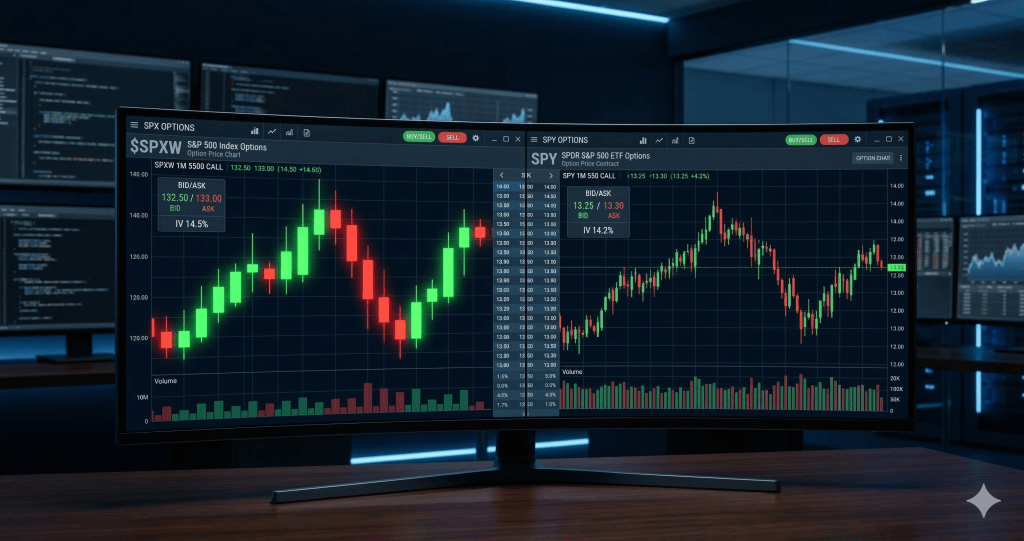
SPX trades at roughly 10 times the price of SPY. If SPX is at 5,500 and you buy a slightly out-of-the-money call at USD 10.00 per contract, you are paying USD 1,000 (USD 10.00 x 100 multiplier). The same relative trade on SPY at 550 might cost USD 100–200 per contract.
Bottom line:
- SPX is better suited for accounts of USD 25,000 and above
- SPY is more accessible for accounts of USD 5,000 to USD 25,000
2. Tax Treatment
This is where SPX has a significant, often overlooked advantage.
SPX options qualify as Section 1256 contracts under IRS rules. This means:
- 60% of gains are taxed as long-term capital gains regardless of how long you held the position
- 40% of gains are taxed as short-term capital gains
- This blended rate is almost always lower than the flat short-term rate applied to SPY options
SPY options are taxed as standard equity options — all gains are short-term capital gains if held under a year, which for active traders is essentially always.
For a trader generating USD 50,000 in annual profits, the tax difference between SPX and SPY can easily amount to USD 3,000–USD 8,000 or more depending on your tax bracket. Consult a tax professional for your specific situation.
3. Settlement Style and Assignment Risk
SPX options are European style — they can only be exercised at expiration. This eliminates early assignment risk entirely. You will never wake up to find yourself holding an unexpected position because a counterparty exercised early.
SPY options are American style — they can be exercised at any point. While early assignment on long options is rare, it becomes a real consideration for certain spread strategies around ex-dividend dates. SPY pays a quarterly dividend, which can trigger early assignment on in-the-money calls.
For simple directional trades (buying calls or puts), this distinction matters less. For spread traders, SPX’s European style is a meaningful advantage.
4. Liquidity and Bid-Ask Spreads
Both SPX and SPY options are among the most liquid in the world, but they differ in how that liquidity manifests.
- SPX has extremely tight bid-ask spreads relative to its price point, especially on front-month contracts and near-the-money strikes. Institutional participation is very high.
- SPY has the highest raw options volume of any instrument globally. Spreads are extremely tight in absolute dollar terms, making it easier for smaller accounts to enter and exit cleanly.
For most active retail traders, liquidity is not a limiting factor in either market.
5. Precision and Granularity
Because SPX trades at a much higher price than SPY, strikes are spaced further apart in absolute terms. SPX might have strikes every 5 or 10 points, while SPY has strikes at every USD 1.00 increment.
For traders who want very precise strike selection — for example, targeting a specific supply or demand zone — SPY can offer more granularity at lower price points. For traders working with larger positions, SPX offers more efficient capital deployment per contract.
Which Should You Choose?
Here is a straightforward decision framework:
Choose SPX if:
- Your account is USD 25,000 or larger
- You want the Section 1256 tax advantage
- You want to eliminate early assignment risk
- You are making directional plays on daily or weekly index setups
- You want to trade extended hours
Choose SPY if:
- Your account is under USD 25,000
- You are learning options mechanics and want smaller position sizes
- You are running spread strategies where granular strike selection matters
- You want maximum flexibility with American-style exercise
A note on RUT and IWM: The same dynamic applies to RUT (Russell 2000 Index options) vs IWM (Russell 2000 ETF options). RUT offers the Section 1256 tax treatment and cash settlement; IWM does not. At Blueville Capital we cover both pairs — SPX/SPY and RUT/IWM — depending on where the strongest setups appear each day.
How Blueville Capital Trades Both Markets
At Blueville Capital, we issue daily trade alerts on SPX, RUT, SPY, and IWM — using supply and demand zone analysis to identify high-probability entries targeting 50%+ profit on each setup. We do not pick one instrument and ignore the others. The market tells us where the best setup is that day, and we follow it.
Members receive alerts for all four instruments, with clear entry areas, targets, and invalidation levels. Our published trade history is fully transparent — you can see exactly how each alert has performed over time before you commit to a membership.
For members who want to understand the mechanics behind instrument selection, position sizing, and zone analysis at a deeper level, our one-on-one mentorship program covers all of it across four two-hour sessions.
👉 blueville.capital
FAQs
Q: Is SPX or SPY better for beginners? A: SPY is generally better for beginners due to its smaller contract size, which allows you to risk less per trade while you are still learning. Once your account grows to USD 25,000 or more and you understand options mechanics, transitioning to SPX makes sense for the tax advantage alone.
Q: Do SPX options have better tax treatment than SPY? A: Yes. SPX options are Section 1256 contracts, meaning 60% of gains are taxed at the long-term capital gains rate and 40% at the short-term rate — regardless of holding period. SPY options are taxed as standard equity options, with all short-term gains taxed at your ordinary income rate. Consult a tax professional for advice specific to your situation.
Q: Can I trade SPX options with a small account? A: Technically yes, but the contract size makes it difficult to manage risk properly with accounts under USD 25,000. SPY is a better fit for smaller accounts because the lower per-contract cost gives you more flexibility in sizing.
Q: What is the difference between European and American style options? A: European style options (like SPX) can only be exercised at expiration. American style options (like SPY) can be exercised at any point before expiration. For directional traders buying calls or puts, this distinction has minimal practical impact. For spread traders, European style eliminates early assignment risk.
Q: Why does SPX have a tax advantage over SPY? A: SPX options are classified as Section 1256 contracts under IRS rules because they are based on a broad-based index rather than an ETF. ETF options like SPY do not qualify for this treatment. The 60/40 tax split on Section 1256 contracts typically results in a lower effective tax rate on trading profits.
Q: Are RUT options similar to SPX options? A: Yes. RUT (Russell 2000 Index) options share the same key advantages as SPX — cash settlement, European style, and Section 1256 tax treatment. IWM (the Russell 2000 ETF) is the equivalent of SPY in the Russell 2000 space. The same decision framework applies.
Q: Does Blueville Capital trade SPX or SPY? A: Both. Blueville Capital issues daily trade alerts across SPX, RUT, SPY, and IWM — wherever the strongest supply and demand setups appear that day. Members get access to all four instruments.
Conclusion
SPX and SPY are not competitors — they are complementary instruments that serve different account sizes and strategies. If your account is large enough, SPX gives you the tax advantage, cleaner settlement, and institutional-grade liquidity. If you are building your account, SPY gives you the flexibility and granularity to manage risk precisely while you develop your edge.
At Blueville Capital, we trade both — and our published trade history shows exactly how each setup has performed. No guessing, no hype. Just daily setups with defined risk and real targets.
👉 blueville.capital
Disclaimer: Options trading involves significant financial risk and is not suitable for all investors. Past performance does not guarantee future results. Tax treatment information in this article is for general educational purposes only and does not constitute tax advice. Consult a licensed tax professional regarding your specific situation. All references to targeting 50%+ profit reflect potential setups based on historical zone analysis and are not guarantees of any specific return.