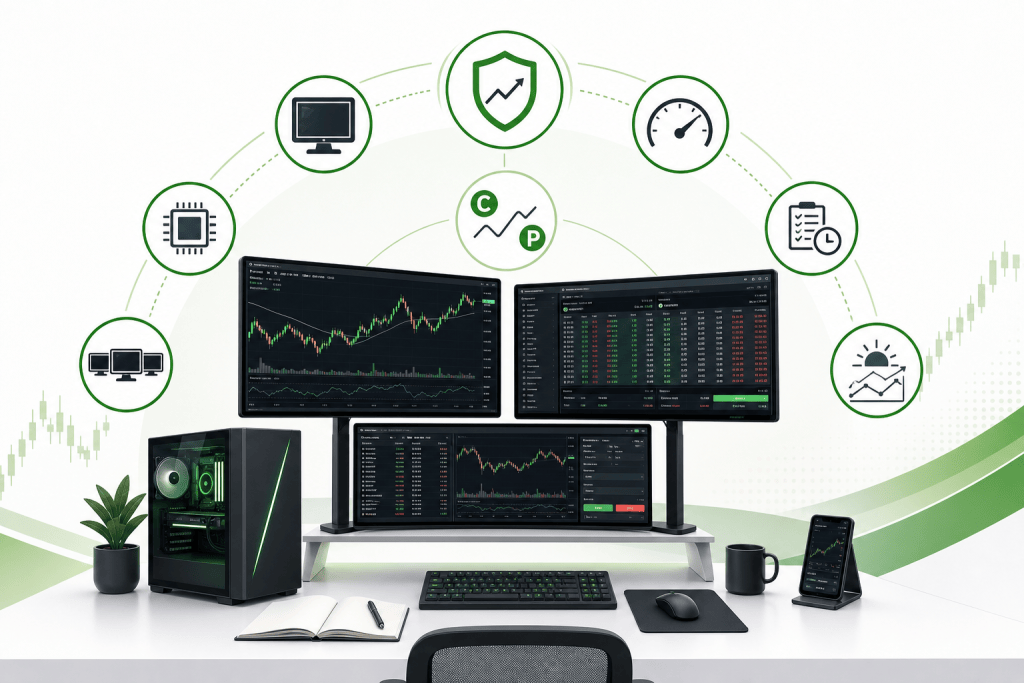
Most beginner options trading resources cover stock options and call it done. This options trading for beginners guide focuses on index products specifically, SPX, RUT, SPY, and IWM, because those instruments carry structural mechanics that generic beginner material skips entirely. Work through this guide in order and you will have the vocabulary and framework to approach an index options chain without guessing.
What Are Options and Why Are Index Options Different?
The failure pattern is almost always the same: a beginner reads a general options guide, learns what calls and puts are, and then opens an SPX chain expecting it to behave like an Apple or Tesla option. It does not. The structural differences are not minor footnotes. They change how you enter, exit, and manage every trade.
A call option gives you the right to buy the underlying at a set strike price before expiration. A put option gives you the right to sell. Both involve paying a premium, which is the price of the contract, and both expire worthless if the underlying never reaches your strike. That much applies to all listed options.
Index options break from that template in two critical ways.
Settlement style. Stock options settle by delivering shares. When an SPX call expires in-the-money, no shares change hands. The difference between the strike price and the final settlement value is paid out in cash. You never hold the underlying, because there is no underlying to hold. This matters at expiration: you cannot exercise an SPX option and receive stock.
Exercise style. Stock options are American-style, meaning you can exercise them at any point before expiration. SPX and RUT options are European-style: exercise only happens at expiration. You can still sell the contract before expiration, but early exercise is not available. SPY and IWM are American-style, which is one reason some traders prefer them when flexibility matters.
These two differences, cash settlement and European exercise, create scenarios that catch beginners off guard. A deep in-the-money SPX call the day before expiration cannot be exercised early to lock in a gain. You either sell it in the market or hold through final settlement. Understanding this before you place a trade is not optional.
For a full treatment of how these mechanics interact with intraday index trade structure, Day Trading for Beginners: How Index Options Work covers the session-by-session behavior of SPX and SPY in detail. According to SEC staff analysis reported by joincfu.com, roughly 5.3 million individual customers engaged in U.S.-listed options trading between November 2022 and the end of 2025, and the Options Clearing Corporation reported that U.S.-listed options volume reached a record 15.21 billion contracts in 2025. Most of those participants are trading without a clear understanding of what product they are actually in.
Key Options Terms Every Beginner Must Know
Before you can read an options chain with any conviction, you need a working vocabulary. The terms below are the ones you will encounter in the first five minutes of looking at an SPX or SPY chain.
Strike price. The price level at which the option gives you the right to buy (call) or sell (put) the underlying. SPX lists strikes at multiple increments depending on the expiration and distance from the current price.
Expiration date. The date on which the option contract expires. SPX is available across multiple expiration cycles, from same-day to monthly. Choosing the wrong expiration for your time horizon is one of the most common structural errors beginners make.
Premium. The price you pay for the option contract, quoted per share. One standard contract covers 100 shares of the notional underlying, so a premium of three dollars costs three hundred dollars per contract. That is your maximum loss on a long option.
In-the-money (ITM). A call is in-the-money when the underlying is above the strike price. A put is in-the-money when the underlying is below the strike price. ITM options carry intrinsic value.
Out-of-the-money (OTM). The opposite: the underlying has not yet reached the strike. OTM options carry no intrinsic value. Their entire premium is time value.
Intrinsic value. The built-in profit of an option at current market levels. For a call with a strike below the current SPX price, the intrinsic value is the difference between the two levels. Intrinsic value cannot go below zero.
Time value (extrinsic value). The portion of the premium above intrinsic value. It reflects how much time remains before expiration and how much volatility the market expects. Time value erodes as expiration approaches. This erosion is called Theta decay, and it works against you on every long option you hold.
Bid/ask spread. The gap between what buyers will pay and what sellers will ask. On actively traded index products, the spread at strikes near the current price tends to be tighter than on thinly traded strikes far from it. Entering a trade at the ask and exiting at the bid costs you money before the underlying moves a single point.
Open interest. The total number of open contracts at a given strike. It does not predict direction, but it tells you where significant exposure exists across the market.
How to Read an Index Options Chain Step by Step
An options chain is a grid. Calls sit on one side, puts on the other, with strikes running down the center. Every column is a data point. The failure pattern for beginners is scanning the chain visually and picking a strike based on premium size alone. That is not reading a chain. That is guessing with extra steps.
Work through the chain this way:
-
Orient yourself to the current price. Find where the underlying is trading right now. On an SPX chain, that level divides in-the-money calls (strikes below the current price) from out-of-the-money calls (strikes above it). The reverse applies to puts. This orientation tells you immediately where intrinsic value exists and where you are paying purely for time and volatility.
-
Choose your directional side. [S1] Choose between call options for upward price expectations or put options for downward expectations. Do not pick a side because the premium looks cheap. Pick a side because you have a structural reason to expect price to move in that direction.
-
Select an expiration that matches your trade horizon. A same-day SPX option expires at the close of that session. A weekly expires at the end of that week. The shorter the expiration, the faster time value erodes. If you are learning, avoid same-day expirations until you understand how Theta and Gamma interact near expiration.
-
Read the bid and ask columns. The bid is what the market will pay you to sell the contract. The ask is what you will pay to buy it. The midpoint is a reasonable target for a limit order on liquid index products. Never enter a market order on an options contract.
-
Check the volume and open interest columns. Volume tells you how many contracts have traded today. Open interest tells you how many remain open from prior sessions. A strike with high open interest and active volume has a functioning market. A strike with near-zero volume on both sides is illiquid and carries execution risk.
-
[S2] Calculate the intrinsic value to determine the built-in profit of the option at current market levels. Subtract the strike from the current underlying price for a call (or the reverse for a put). Whatever remains above that figure in the premium is time value. Knowing this split tells you how much of your premium is at risk from time decay alone.
An Introduction to the Greeks: What Delta, Theta, and Vega Mean for Index Trades
The Greeks are not decoration on an options chain. They are the variables that determine whether a trade that looks correct on direction still loses money. Beginners who skip them discover this the hard way: the underlying moves in their favor and the option barely budges, or it moves against them and the option collapses faster than expected. That outcome has a structural explanation, and the Greeks provide it.
Delta measures how much an option's price changes for every one-point move in the underlying. At-the-money options carry a Delta near the midpoint of the 0-to-1 range, deep in-the-money options approach 1.00, and far out-of-the-money options sit much closer to zero. Delta also functions as a rough proxy for the probability that an option finishes in-the-money at expiration, though it is not a precise probability measure and should not be treated as one.
Theta measures daily time decay: how much premium the option loses with each passing day, all else equal. Theta works against every long option position. It is not a risk you can avoid by picking the right direction. On short-dated index contracts, time value erodes as expiration approaches. If you hold a long option into the final session and the underlying stalls, Theta can erase a significant portion of the premium even without an adverse move.
Vega measures sensitivity to changes in implied volatility. When implied volatility rises, option premiums expand. When it falls, they compress. This matters on index products because implied volatility can shift around scheduled macro events. Buying an option before a high-volatility event and holding it through resolution can produce a Vega loss even when the direction call is correct, because the drop in implied volatility after the event compresses the premium.
Gamma measures the rate at which Delta itself changes. High Gamma means your Delta is moving quickly as the underlying moves. On short-dated index options near expiration, contracts close to the current price can see their Delta shift rapidly, which amplifies both gains and losses for relatively small moves in the underlying.
Understanding how these four interact is the difference between trading an option and trading a position you understand.
Which Options Trading Strategy Is Best for Beginners?
No single strategy is best for every beginner. The right starting point depends on your risk tolerance, your available capital, and how well you understand the mechanics already covered. What follows are the three most accessible approaches for index options, with honest notes on where each fits and where it does not.
Buying calls or puts outright. This is the most direct approach: you pay a premium, you define your maximum loss at entry, and you need the underlying to move in your direction before expiration. Defined risk is the structural advantage. The disadvantage is that Theta works against you from the moment you enter. On index products, time decay is not theoretical. A long SPX call that sits flat loses value as time passes, regardless of what the underlying does. Outright buying suits traders who have a specific directional conviction and a clear time horizon for the move.
Protective puts. A protective put pairs a long position in an index ETF like SPY or IWM with a put option at or below the current price. The put acts as a floor: if the ETF drops sharply, the put gains value and offsets some of the loss. This strategy suits traders who hold a directional position and want defined downside without exiting the trade. It costs premium, so it reduces net profit if the underlying moves in your favor. Treat it as insurance with a known cost, not a free hedge.
Defined-risk spreads. A vertical spread combines a long option and a short option at different strikes in the same expiration. Buying an SPX call at one strike and selling a call at a higher strike caps both your maximum gain and your maximum loss. The short option reduces your net premium paid, which reduces the Theta drag on the position. Spreads require more chain-reading skill to set up correctly, but they are more forgiving of small timing errors than outright long options.
Why Do So Many Options Traders Lose Money, and How Can Beginners Avoid It?
The failure rate in retail options trading is high. The reasons are structural, not random. Most losing traders share the same set of habits, and those habits interact with the mechanics of options in predictable ways.
Theta decay compounds losses on bad timing. A directional trade that is correct in the long run can still expire worthless if the timing is off. Buying a long option and holding it through a slow, sideways session bleeds premium daily. Beginners underestimate how much of their edge disappears before the underlying moves.
Position sizing errors create outsized losses. Options cost less than shares, which makes it easy to buy more contracts than the position warrants. A small adverse move in SPX can produce a large percentage loss on an out-of-the-money option. Sizing as if the premium is the only risk, without accounting for the magnified exposure embedded in the contract, leads to account damage that cannot be recovered from a single good trade.
Ignoring implied volatility at entry. Buying options when implied volatility is already elevated means paying inflated premiums. If the underlying moves in your direction but volatility drops, the option may gain less than expected or lose value outright. Checking where implied volatility sits relative to its recent range before entering a long option is a basic habit that most beginners skip.
Build these three practices before trading index options live: size each position so the maximum loss on a single trade is a small, fixed percentage of your account; check implied volatility context before buying premium; and set a defined exit point for both a loss and a gain before you enter. Access and opportunity are not the same thing. Having the ability to trade SPX does not mean the conditions warrant it.
When Guided Trade Setups Make Sense for Index Options Beginners
Most beginners reach a point where they understand the mechanics but still cannot translate that knowledge into a consistent pre-trade process. That gap, between knowing what Delta is and knowing which SPX setup to act on today, is where a structured service earns its place.
Blueville Capital is a trade alert and coaching service that delivers daily index options setups on SPX, RUT, SPY, and IWM, built around supply and demand analysis. Members receive live trade alerts, performance tracking, and access to one-on-one coaching for traders who want instruction rather than signals alone. That is not a shortcut to skill. It is a scaffold while you build one.
Prices and plan limits verified as of October 2026.
FAQs
Can you make $100 a day trading options as a beginner?
It is possible in a mechanical sense, but framing it as a daily income target is the wrong way to approach index options. A fixed daily dollar goal pushes beginners to force trades on days when no structural setup exists. A more useful frame: define your risk per trade, set a realistic profit target on each position, and track results over 30 to 60 sessions before drawing any conclusions about consistency.
What is the difference between European-style and American-style options exercise?
American-style options, including SPY and IWM, can be exercised at any point before expiration. European-style options, including SPX and RUT, can only be exercised at expiration. In practice, most traders never exercise either style early, since selling the contract before expiration usually captures more value than exercising it. The distinction matters most when you are deep in-the-money near expiration and want to lock in a gain without waiting for final settlement.
What does cash settlement mean for index options like SPX?
When an SPX option expires in-the-money, no shares change hands. The difference between the strike price and the final settlement value is paid out in cash. You cannot receive or deliver the underlying index because there is no physical underlying to deliver. This also means you cannot be assigned stock on an SPX position, which removes one of the assignment risks that apply to single-stock options.
What position sizing and loss-limit practices do options beginners need?
Before placing any index options trade, set three limits: the maximum you will risk on a single position as a percentage of your account, a daily loss ceiling after which you stop trading, and a profit target you will take before expiration. The specific figures vary by account size and risk tolerance. What matters is that all three are defined before you enter, not after you are already in a losing position.
Are index options better than stock options for beginners?
Not necessarily. Index options offer cash settlement and no single-stock earnings risk, which removes some variables. But they also carry European-style exercise on SPX and RUT, which limits flexibility near expiration, and their premium levels reflect broad market volatility rather than a single company's event calendar. SPY and IWM are often a more accessible starting point for beginners because each contract covers fewer notional dollars than SPX. The better question is whether you understand the specific mechanics of the product you are trading before you enter it.
Conclusion
Index options are not a harder version of stock options. They are a different product with distinct settlement rules, exercise styles, and volatility behavior. Understanding cash settlement, European-style exercise, and how the Greeks interact on short-dated index contracts gives you a structural foundation that most beginner resources skip.
Before you place a trade on SPX, RUT, SPY, or IWM, confirm you can read the chain, size the position relative to your account, and define your exit before entry. Start with SPY or IWM if the notional size of SPX feels large, and use a defined-risk spread rather than an outright long option until you have 20 or more trades logged and reviewed.